
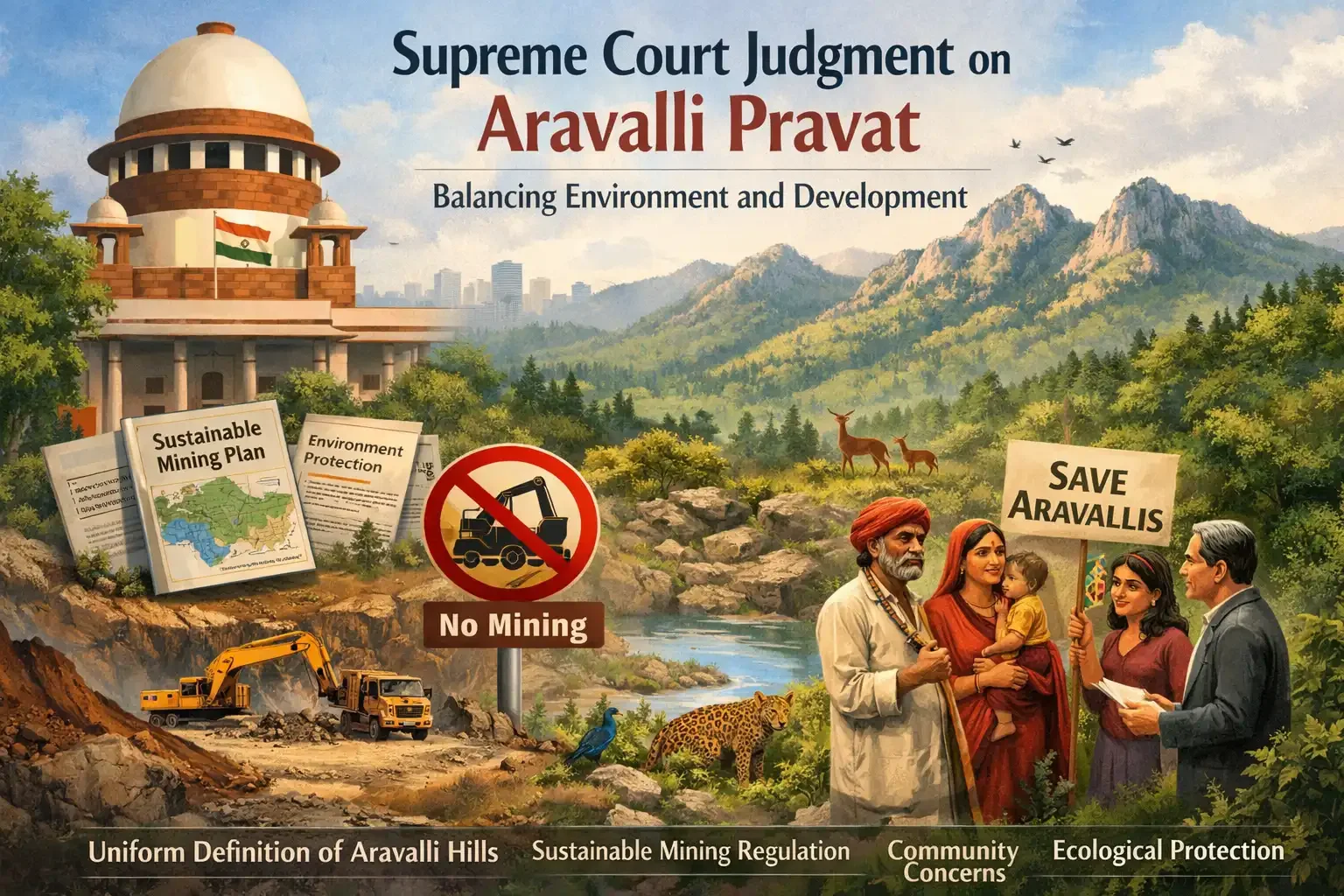
The Supreme Court of India’s recent judgment on the Aravalli Pravat — focusing on the Aravalli hills and their protection — has ignited deep debate across environmental circles, political corridors, rural communities and urban neighbourhoods from Delhi to Rajasthan. This landmark Aravalli judgment seeks to bring uniformity to how these ancient hills are legally defined and managed, especially in relation to mining regulation, but its wider impact raises questions about ecological protection, livelihoods and future planning.
In this blog post, we will unpack the Supreme Court Aravalli decision in clear terms, explore why it matters, look at reactions from different stakeholders, and highlight what lies ahead for regions tied to this fragile ecosystem.
What Exactly Did the Supreme Court Decide?
On 20 November 2025, a Constitution Bench of the Supreme Court accepted the Ministry of Environment, Forest and Climate Change’s (MoEF&CC) scientific definition of the Aravalli hills. Under this Aravalli judgment, a “hill” is defined as a landform that stands 100 metres or more above the surrounding terrain. Similarly, an “Aravalli range” is defined as a cluster of two or more such hills within 500 metres of each other.
This new scientific definition replaces years of inconsistent interpretations used by states like Rajasthan, Haryana, Delhi and Gujarat. The lack of a uniform layout had often led to legal confusion and uneven enforcement of environmental protection laws.
In addition to the definition, the court also directed the government to prepare a Management Plan for Sustainable Mining (MPSM) for the entire Aravalli landscape. This plan is intended to map environmentally sensitive areas, regulate mining activity rigorously and set restoration frameworks for degraded sites. Until this detailed plan is ready, the Supreme Court has ordered a freeze on granting new mining leases.
Taken together, these rulings form the core of the Supreme Court’s Aravalli Pravat judgment — balancing ecological protection with lawful resource extraction.
Why Did the Supreme Court Revisit Aravalli Definitions?
For decades, Aravalli hills have been at the centre of environmental litigation due to widespread illegal mining, deforestation, and construction in violation of existing laws. The Aravalli range — one of the oldest mountain systems on Earth — stretches from Delhi through Haryana and Rajasthan to Gujarat.
Different states were applying varying standards for what constitutes an Aravalli hill or range, leading to loopholes that allowed mining and land clearing in lower hills and scrublands that many scientists argue are ecologically vital. The Supreme Court’s push for a single, uniform definition stems from a belief that clarity in law is essential for enforcement and conservation.
What the Judgment Means: Key Components
1. Uniform Scientific Definition of Aravalli Hills
The judgment standardizes how Aravalli hills are identified across all four states. This clarity is meant to close gaps that previously allowed lower hillocks to be excluded from legal scrutiny.
2. Protection of 90%+ of Aravalli Region
Despite concerns about shrinking protection, the Central government has clarified that over 90% of the Aravalli landscape remains under protection under this framework. New mining leases are also held in suspension pending the sustainable mining plan.
3. Sustainable Mining Management Plan
By pushing the MoEF&CC to prepare a comprehensive mining plan, the appeal is to ensure that any permitted mining is strictly regulated, environmentally sustainable and aligned with scientific mapping.
4. Ban on New Mining Leases
To prevent further ecological damage while the long-term plan is being prepared, the Supreme Court halted the issuance of new mining leases in the Aravalli area.
Different Reactions to the Supreme Court Aravalli Decision
The judgment has drawn a spectrum of responses — from political, expert, community-based, and environmental voices.
Political Response: Controversy and Criticism
Leaders from various parties have weighed in. Senior Congress figures criticised the Supreme Court’s acceptance of the new definition as a potential “road to ecological destruction,” arguing that excluding lower hills could lead to increased mining and habitat loss.
Supporters of the ruling, including leaders from the ruling party in Rajasthan, argue that a scientific definition will ultimately strengthen environmental protection, streamline enforcement and reduce arbitrary interpretations.
Environmental Activists: Alarm Over Long-Term Impact
Several environmental groups and scientists have expressed concern that applying a simple height cutoff could undermine protection of ecologically sensitive low-lying hills, which are crucial for groundwater recharge, biodiversity corridors, dust control, and micro-climate regulation, especially around the National Capital Region.
Some activists also see the judgment as opening doors for renewed mining pressure once loopholes emerge in interpretation, especially if protections are not strongly enforced.
Local Communities and Tribal Voices
Tribal communities in southern Rajasthan have voiced their opposition, highlighting how changes in legal protection could affect lands tied to ancestral heritage, livelihoods, and cultural identities. They emphasise that the hills are not merely geological features but integral to their way of life, water security and traditions.
Environmental Significance of the Aravalli Hills
To understand why this judgment matters so much, it’s important to recognise why the Aravallis are ecologically significant:
-
Natural Barrier and Climate Buffer: The Aravalli range acts as a green buffer that helps moderate dust storms from the Thar Desert and influences local weather patterns.
-
Water Recharge: The fractured rocky terrain enables significant groundwater recharge, crucial for areas where water scarcity is a constant challenge.
-
Biodiversity: The hills and adjoining scrublands support a wide range of plant and animal species, many of which are adapted to this unique environment.
-
Agriculture and Rivers: Several seasonal rivers originate in the Aravalli hills, supporting irrigation and farming communities across Rajasthan and neighbouring states.
Given these roles, any shift in legal protection has potential ripple effects on water security, air quality, rural livelihoods, agriculture, and overall ecological stability.
What Happens Next? Challenges and Opportunities
Drafting and Implementation of Sustainable Mining Plan
The success of this judgment largely depends on how effectively the Management Plan for Sustainable Mining is prepared and implemented. The court’s directions will require multi-state cooperation, detailed scientific surveys, environmental safeguards and strict monitoring.
Balancing Protection and Development
India’s need for mineral resources and infrastructure development must be balanced with environmental conservation. If done right, structured and well-regulated mining can coexist with ecological preservation — but only if legal frameworks are strictly enforced.
Strengthening Local Voices
Local communities, whose livelihoods depend on the hills and related ecosystems, will need platforms to participate in planning, monitoring and benefit-sharing. Their inclusion in decision-making processes could be a key test of democratic environmental governance.
Conclusion: A Watershed Moment for Aravalli Protection
The Supreme Court’s Aravalli Pravat judgment marks a significant legal intervention in environmental governance. By insisting on a uniform scientific definition and sustainable mining guidelines, the court has attempted to bring legal clarity to one of India’s most contested ecological zones.
However, the long-term success of this Supreme Court Aravalli decision will hinge on strong implementation, careful scientific mapping, and meaningful community engagement. The challenge now is to ensure that the legal clarity the court seeks truly translates into ecological protection, sustainable development and secure livelihoods for millions dependent on the Aravalli landscape.









0 Comments
No comments yet. Be the first to comment!